TOKYO (Reuters) - U.S. stock futures and Asian shares dipped after North Korea fired another missile over Japan into the Pacific Ocean on Friday, demonstrating Pyongyang's defiance in the face of intensifying sanctions.
U.S. stock futures <ESc1> fell 0.2 percent while MSCI's Asia-Pacific share index excluding Japan <.MIAPJ0000PUS> shed 0.4 percent, though it was still up 0.4 percent on the week.
Japan's Nikkei <.N225> ticked up 0.1 percent.
Japan said the North Korean missile fell into sea about 2,000 km (1,240 miles) east of Hokkaido.
The launch came just days after the U.N. Security Council approved new sanctions against Pyongyang for its Sept. 3 nuclear test, but markets are growing accustomed to North Korea's sabre-rattling.
"There have been reports suggesting North Korea is preparing a missile launch, so this was by no means a surprise," said Hirokazu Kabeya, chief global strategist at Daiwa Securities.
"Also, in the past, markets have stabilised within a few days after a North Korean missile launch. So in a way this seems like something markets have already experienced before, thus producing a limited reaction," he added.
Before North Korea's missile launch, U.S. bond yields had risen while Wall Street shares were mixed after U.S. consumer inflation data rekindled expectations that the Federal Reserve will raise interest rates in December.
The consumer price index rose 0.4 percent in August from July, faster than the 0.3 percent increase forecast by analysts in a Reuters poll.
The so-called core CPI, which excludes volatile energy and food prices, rose 0.2 percent. On a 12-month basis, it was 1.7 percent, above the 1.6 percent forecast by economists.
Following the data, the U.S. Fed funds rate futures <FFF8> were pricing in a roughly 45 percent chance the Fed will raise rates by December, compared to around 25 percent at the start of this week.
The 10-year U.S. Treasuries yield <US10YT=RR> rose to as high as 2.225 percent, but slipped back to 2.178 percent in Asia on Friday following North Korea's missile launch.
In currency markets, the dollar failed to capitalise on the CPI data as the rally it begun at the start of the week ran out of steam.
The euro traded at $1.1910 <EUR=>, off Thursday's two-week low of $1.18365.
The British pound held firm after the Bank of England warned it might raise interest rates for the first time in a decade in the "coming months" if the economy and price pressures keep growing.
The pound hit a one-year high of $1.3407 on Thursday and last stood at $1.3388 <GBP=D4>.
Oil prices were lower on Friday but largely held gains that had prices flirting with multi-month highs, as the cleanup after hurricanes in the United States gathered pace and the outlook for demand took on a firmer tone.
Brent crude futures <LCOc1> traded at $55.14 per barrel, down 0.6 percent on the day but up 2.5 percent on the week. They hit a five-month high of $55.99 on Thursday.
Elsewhere, bitcoin <BTC=BTSP> bounced back 5 percent after having tumbled 16 percent the previous day as Chinese news outlet Yicai reported that the country plans to shut down all bitcoin exchanges by the end of September.
BTCChina, one of China's top three exchanges, said on Thursday that it would stop all trading from Sept. 30.
Thursday, 14 September 2017
South Korea's Hyundai launches new Genesis sports sedan in SUV-driven market
SEOUL, Sept 15 (Reuters) - South Korea's Hyundai Motor Co will launch its first new sedan under the premium Genesis marque in Seoul on Friday, hoping to cement the brand's place in the luxury segment and make up for its lack of a strong SUV line-up.
U.S. pop singer Gwen Stefani will perform for about 10,000 people at a gala event to launch of the G70, the third sedan to carry the Genesis name but the first to be marketed exclusively under Hyundai Motor's fledgling premium brand.
Starting from $33,000, the sporty four-door offers bang for the buck as it takes on rivals including affiliate Kia Motor's Stinger sedan and BMW's 3 series.
But analysts say the G70 will not solve Hyundai's troubles in the United States, where sports utility vehicles (SUVs) are all the rage and the two previous Genesis-branded sedans failed to take off.
"Look at Cadillac, with just one crossover, the brand is struggling in the U.S. It will be much the same story for Genesis until they can get a crossover to market," said Dave Sullivan, product analysis manager at U.S. consultancy AutoPacific.
"It's not because the G70 will be a bad product ... The sedan lineup just doesn't match consumer demand."
The G70 debuts in South Korea on Friday followed by the United States next year. Hyundai has not said when it would enter China and Europe, which are dominated by German premium brands.
Hyundai's China sales tumbled more than 60 percent in the second quarter due to its lack of a strong SUV line-up and political tensions between China and South Korea over North Korea's nuclear weapons programme.
In the United States, SUVs made up 35 percent of Hyundai's total U.S. sales from January to August this year, far lower than the industry's 62 percent, according to U.S. researcher Autodata.
CRITICAL TEST
The Genesis project is being closely watched by Hyundai Vice Chairman and heir apparent Chung Eui-sun, as he prepares to take over the world's No.5 auto group from his father, 79-year-old Chairman Chung Mong-koo.
As the first Genesis model which was not previously sold as a Hyundai, the G70 will be a key test of the two-year-old marque's ability to survive in a fiercely competitive field.
Its chief rival will be Hyundai affiliate Kia's slightly cheaper Stinger, which shares the same platform as the G70 and launched in late April. Other rivals include BMW's 3 series, Audi's A4 and Mercedes-Benz's C-class.
Hyundai has said the Genesis line-up will grow to six by 2020, with the addition of a sports coupe and two SUVs. ($1 = 1,132.5000 won)
U.S. pop singer Gwen Stefani will perform for about 10,000 people at a gala event to launch of the G70, the third sedan to carry the Genesis name but the first to be marketed exclusively under Hyundai Motor's fledgling premium brand.
Starting from $33,000, the sporty four-door offers bang for the buck as it takes on rivals including affiliate Kia Motor's Stinger sedan and BMW's 3 series.
But analysts say the G70 will not solve Hyundai's troubles in the United States, where sports utility vehicles (SUVs) are all the rage and the two previous Genesis-branded sedans failed to take off.
"Look at Cadillac, with just one crossover, the brand is struggling in the U.S. It will be much the same story for Genesis until they can get a crossover to market," said Dave Sullivan, product analysis manager at U.S. consultancy AutoPacific.
"It's not because the G70 will be a bad product ... The sedan lineup just doesn't match consumer demand."
The G70 debuts in South Korea on Friday followed by the United States next year. Hyundai has not said when it would enter China and Europe, which are dominated by German premium brands.
Hyundai's China sales tumbled more than 60 percent in the second quarter due to its lack of a strong SUV line-up and political tensions between China and South Korea over North Korea's nuclear weapons programme.
In the United States, SUVs made up 35 percent of Hyundai's total U.S. sales from January to August this year, far lower than the industry's 62 percent, according to U.S. researcher Autodata.
CRITICAL TEST
The Genesis project is being closely watched by Hyundai Vice Chairman and heir apparent Chung Eui-sun, as he prepares to take over the world's No.5 auto group from his father, 79-year-old Chairman Chung Mong-koo.
As the first Genesis model which was not previously sold as a Hyundai, the G70 will be a key test of the two-year-old marque's ability to survive in a fiercely competitive field.
Its chief rival will be Hyundai affiliate Kia's slightly cheaper Stinger, which shares the same platform as the G70 and launched in late April. Other rivals include BMW's 3 series, Audi's A4 and Mercedes-Benz's C-class.
Hyundai has said the Genesis line-up will grow to six by 2020, with the addition of a sports coupe and two SUVs. ($1 = 1,132.5000 won)
China to close all bitcoin exchanges by end-September: Yicai
LONDON (Reuters) - China plans to shut the country’s bitcoin exchanges by the end of September, Chinese financial news outlet Yicai said on Thursday, citing sources.
“It has been set for the end of September, the order has come from above,” Yicai said, citing Shanghai financial sources, adding that the exchanges will be ordered to leave the market.
Earlier, BTCChina, one of the country’s largest cryptocurrency exchanges, said it would stop all trading from Sept. 30. It said its decision was based on a Sept. 4 directive from Chinese authorities that expressed concern over investment risks involved in cryptocurrencies.
“It has been set for the end of September, the order has come from above,” Yicai said, citing Shanghai financial sources, adding that the exchanges will be ordered to leave the market.
Earlier, BTCChina, one of the country’s largest cryptocurrency exchanges, said it would stop all trading from Sept. 30. It said its decision was based on a Sept. 4 directive from Chinese authorities that expressed concern over investment risks involved in cryptocurrencies.
Google hit with class action lawsuit over gender pay
Google faces a new lawsuit accusing it of gender-based pay discrimination. A lawyer representing three female former Google employees is seeking class action status for the claim.
The suit, filed Thursday in San Francisco Superior Court, follows a federal labor investigation that made a preliminary finding of systemic pay discrimination among the 21,000 employees at Google’s headquarters in Mountain View, California. The initial stages of the review found women earned less than men in nearly every job classification.
Google disputes those findings and says its analysis shows no gender pay gap.
The suit, led by lawyer James Finberg of Altshuler Berzon LLP, is on behalf of three women — Kelly Ellis, Holly Pease and Kelli Wisuri — who all quit after being put on career tracks that they claimed would pay them less than their male counterparts. The suit aims to represent thousands of Google employees in California and seeks lost wages and a slice of Google’s profits.
“I have come forward to correct a pervasive problem of gender bias at Google,” Ellis said in a statement. She says she quit Google in 2014 after male engineers with similar experience were hired to higher-paying job levels and she was denied a promotion despite excellent performance reviews. “It is time to stop ignoring these issues in tech.”
Google spokeswoman Gina Scigliano said the company will review the suit in detail, “but we disagree with the central allegations.”
“Job levels and promotions are determined through rigorous hiring and promotion committees, and must pass multiple levels of review, including checks to make sure there is no gender bias in these decisions,” she said.
Charges of gender discrimination have swirled at Alphabet Inc.-owned Google since the U.S. Labor Department sued in January to bar Google from doing business with the federal government until it released thousands of documents related to an audit over its pay practices. The sides have been battling in court over how much information Google must turn over.
The lawsuit also follows the firing of male engineer James Damore, who wrote a memo circulated on internal message boards that blamed inherent differences between men and women for the underrepresentation of women in engineering roles.
AP
The suit, filed Thursday in San Francisco Superior Court, follows a federal labor investigation that made a preliminary finding of systemic pay discrimination among the 21,000 employees at Google’s headquarters in Mountain View, California. The initial stages of the review found women earned less than men in nearly every job classification.
Google disputes those findings and says its analysis shows no gender pay gap.
The suit, led by lawyer James Finberg of Altshuler Berzon LLP, is on behalf of three women — Kelly Ellis, Holly Pease and Kelli Wisuri — who all quit after being put on career tracks that they claimed would pay them less than their male counterparts. The suit aims to represent thousands of Google employees in California and seeks lost wages and a slice of Google’s profits.
“I have come forward to correct a pervasive problem of gender bias at Google,” Ellis said in a statement. She says she quit Google in 2014 after male engineers with similar experience were hired to higher-paying job levels and she was denied a promotion despite excellent performance reviews. “It is time to stop ignoring these issues in tech.”
Google spokeswoman Gina Scigliano said the company will review the suit in detail, “but we disagree with the central allegations.”
“Job levels and promotions are determined through rigorous hiring and promotion committees, and must pass multiple levels of review, including checks to make sure there is no gender bias in these decisions,” she said.
Charges of gender discrimination have swirled at Alphabet Inc.-owned Google since the U.S. Labor Department sued in January to bar Google from doing business with the federal government until it released thousands of documents related to an audit over its pay practices. The sides have been battling in court over how much information Google must turn over.
The lawsuit also follows the firing of male engineer James Damore, who wrote a memo circulated on internal message boards that blamed inherent differences between men and women for the underrepresentation of women in engineering roles.
AP
Daimler delivers first electric trucks: 'The game has started'
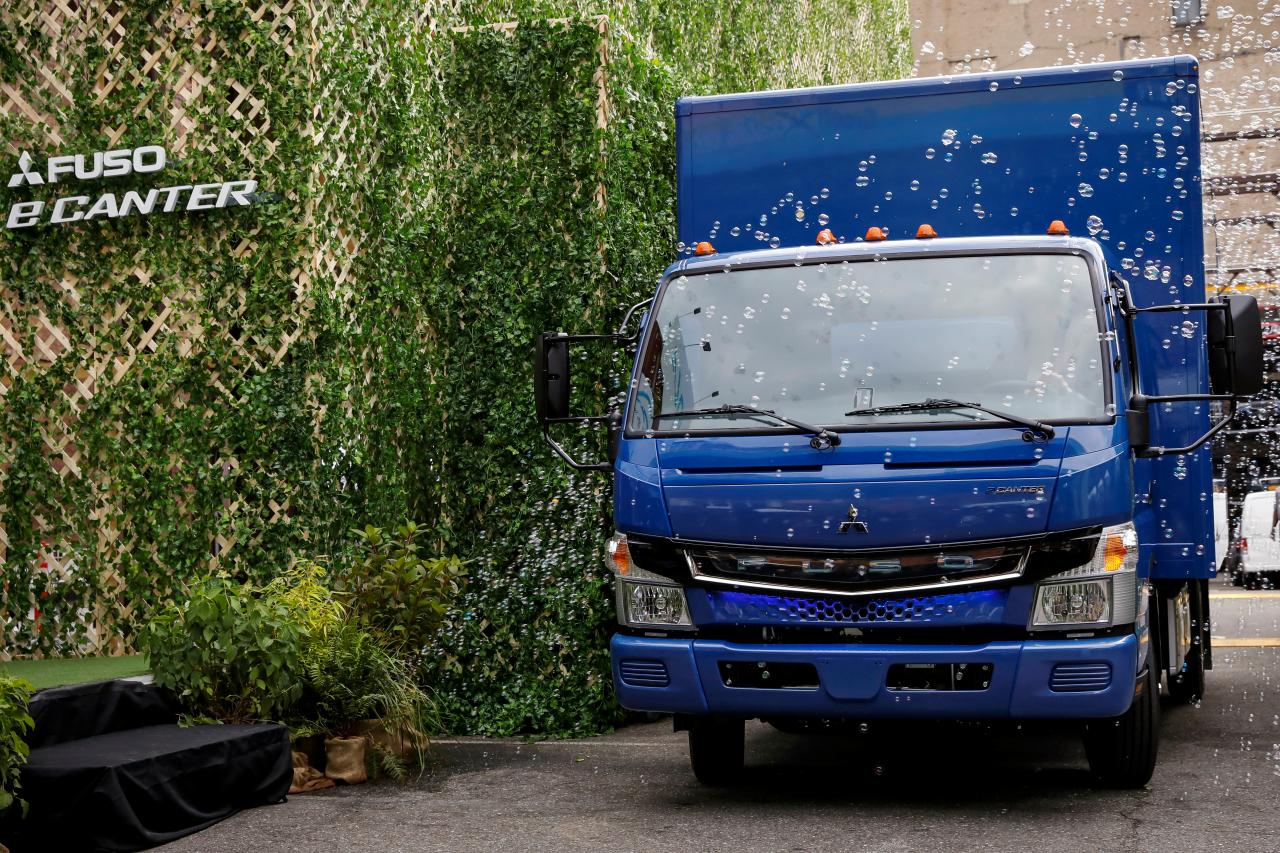
DETROIT (Reuters) - Daimler AG (DAIGn.DE) on Thursday said United Parcel Service Inc(UPS.N) will be the first U.S. commercial customer for its new battery-powered eCanter truck, and the company will expand its electric truck production as lower cost, longer-range batteries become available within two to three years.
The market for electric medium- and heavy-duty trucks is in its infancy. Manufacturers such as Daimler and Navistar International Corp (NAV.N), as well as electric car maker Tesla Inc (TSLA.O) and a host of other new entrants, are racing to overcome the challenges of substituting batteries for diesel engines as regulators crack down on carbon dioxide and soot pollution.
“The game has started,” Daimler Trucks Asia chief Mark Llistosella told Reuters in an interview on Thursday. The Fuso eCanter is a relatively small urban delivery truck, but Llistosella said larger, Class 7 electric trucks are coming and hinted that Daimler will show a larger electric truck at the Tokyo Motor Show next month.
Daimler said at a news conference in New York on Thursday that UPS will deploy three of the eCanter trucks, while four New York based non-profit organizations will get a total of eight electric trucks. The trucks have a range of about 62 miles (100 kms between charges.
Daimler is leasing the trucks to UPS, Llistosella said, because within about two years “we know there will be a next level of technology” that will produce batteries with longer range, lower cost and lower weight.
Battery costs that are currently about $180 to $200 a kilowatt-hour could drop to about $100 a kilowatt-hour, Llistosella said. “This is the main lever” to move electric commercial trucks to higher sales volumes, he said.
Daimler is limiting sales of the eCanter to about 500 vehicles for the first two years of production, in anticipation of the improved batteries, Llistosella said. “The market demand is much higher.”
Daimler’s Mitsubishi Fuso unit began building eCanter trucks at factories in Portugal and Japan earlier this year.
Tesla Chief Executive Officer Elon Musk tweeted on Wednesday that the Silicon Valley company would show off a prototype of an electric semi-trailer truck on Oct. 26 in Hawthorne, California.
“Worth seeing this beast in person,” Musk tweeted. “It’s unreal.”
Reuters reported last month that Tesla’s semi is expected to offer a range of 200 to 300 miles, far less than the 1,000 miles for some diesel-powered counterparts that U.S. long-haul truckers use.
Tesla is also working on self-driving trucks.
The market for electric medium- and heavy-duty trucks is in its infancy. Manufacturers such as Daimler and Navistar International Corp (NAV.N), as well as electric car maker Tesla Inc (TSLA.O) and a host of other new entrants, are racing to overcome the challenges of substituting batteries for diesel engines as regulators crack down on carbon dioxide and soot pollution.
“The game has started,” Daimler Trucks Asia chief Mark Llistosella told Reuters in an interview on Thursday. The Fuso eCanter is a relatively small urban delivery truck, but Llistosella said larger, Class 7 electric trucks are coming and hinted that Daimler will show a larger electric truck at the Tokyo Motor Show next month.
Daimler said at a news conference in New York on Thursday that UPS will deploy three of the eCanter trucks, while four New York based non-profit organizations will get a total of eight electric trucks. The trucks have a range of about 62 miles (100 kms between charges.
Daimler is leasing the trucks to UPS, Llistosella said, because within about two years “we know there will be a next level of technology” that will produce batteries with longer range, lower cost and lower weight.
Battery costs that are currently about $180 to $200 a kilowatt-hour could drop to about $100 a kilowatt-hour, Llistosella said. “This is the main lever” to move electric commercial trucks to higher sales volumes, he said.
Daimler is limiting sales of the eCanter to about 500 vehicles for the first two years of production, in anticipation of the improved batteries, Llistosella said. “The market demand is much higher.”
Daimler’s Mitsubishi Fuso unit began building eCanter trucks at factories in Portugal and Japan earlier this year.
Tesla Chief Executive Officer Elon Musk tweeted on Wednesday that the Silicon Valley company would show off a prototype of an electric semi-trailer truck on Oct. 26 in Hawthorne, California.
“Worth seeing this beast in person,” Musk tweeted. “It’s unreal.”
Reuters reported last month that Tesla’s semi is expected to offer a range of 200 to 300 miles, far less than the 1,000 miles for some diesel-powered counterparts that U.S. long-haul truckers use.
Tesla is also working on self-driving trucks.
iPhone X release date, specs and price: Face ID fail blamed on clumsy staffers
iPhone X is official, with the firm unveiling the 10th-anniversary device at its much-hyped Apple Event on Tuesday.
The iPhone X (pronounced iPhone 10) is the company's first smartphone to feature a full-screen display, as it sets its sights on the likes of the Galaxy Note 8. There's also an all-new 'Super Retina' resolution, a reinforced glass design and support for wireless charging, with the iPhone X arriving with support for the Qi charging standard.
We've rounded up everything we know about the iPhone X below, and will update this article as soon as we hear more.
Release date
As expected, the iPhone X won't be released at the same time as the new iPhone 8 and iPhone 8 Plus, which will start shipping on 22 September.
Instead, Apple has announced that iPhone X pre-orders will begin on 27 October, with shipping to begin 3 November.
Price
The iPhone X will be made available in 64GB and 256GB configurations, which will fetch £999 and £1,149 in the UK, respectively. Pricing in the US starts at $999.
Apple will also make the handset available through its iPhone Upgrade Program, with monthly payments starting at £56.45.
Naturally, Carphone Warehouse has been quick to announce that it'll be stocking the three new iPhones, and pre-registration has kicked off for the iPhone X along with the iPhone 8 and iPhone 8 Plus. Mobiles.co.uk, part of the Dixons Carphone Group, has also opened up pre-registrations.
EE will be selling the iPhone X, iPhone 8 and iPhone 8 Plus, and has been quick to launch a registration page for interested customers. It will also be the only UK network to offer the Apple Watch 3.
O2 will be ranging both the iPhone 8 and iPhone X when pre-orders begin on 15 September and 27 October, respectively.
UK operator Three has been quick to announced that it will offer all three new iPhones but has yet to cough on pricing details.
Vodafone has confirmed that it will offer the iPhone X, as well as both the iPhone 8 and iPhone 8 Plus. Interested customers can register their interest here.
Virgin Mobile has confirmed that it will be selling the iPhone X, as well as Apple's iPhone 8 and 8 Plus handsets.
Read full story on The INQUIRER
The iPhone X (pronounced iPhone 10) is the company's first smartphone to feature a full-screen display, as it sets its sights on the likes of the Galaxy Note 8. There's also an all-new 'Super Retina' resolution, a reinforced glass design and support for wireless charging, with the iPhone X arriving with support for the Qi charging standard.
We've rounded up everything we know about the iPhone X below, and will update this article as soon as we hear more.
Release date
As expected, the iPhone X won't be released at the same time as the new iPhone 8 and iPhone 8 Plus, which will start shipping on 22 September.
Instead, Apple has announced that iPhone X pre-orders will begin on 27 October, with shipping to begin 3 November.
Price
The iPhone X will be made available in 64GB and 256GB configurations, which will fetch £999 and £1,149 in the UK, respectively. Pricing in the US starts at $999.
Apple will also make the handset available through its iPhone Upgrade Program, with monthly payments starting at £56.45.
Naturally, Carphone Warehouse has been quick to announce that it'll be stocking the three new iPhones, and pre-registration has kicked off for the iPhone X along with the iPhone 8 and iPhone 8 Plus. Mobiles.co.uk, part of the Dixons Carphone Group, has also opened up pre-registrations.
EE will be selling the iPhone X, iPhone 8 and iPhone 8 Plus, and has been quick to launch a registration page for interested customers. It will also be the only UK network to offer the Apple Watch 3.
O2 will be ranging both the iPhone 8 and iPhone X when pre-orders begin on 15 September and 27 October, respectively.
UK operator Three has been quick to announced that it will offer all three new iPhones but has yet to cough on pricing details.
Vodafone has confirmed that it will offer the iPhone X, as well as both the iPhone 8 and iPhone 8 Plus. Interested customers can register their interest here.
Virgin Mobile has confirmed that it will be selling the iPhone X, as well as Apple's iPhone 8 and 8 Plus handsets.
Read full story on The INQUIRER
Wednesday, 9 August 2017
Toyota says to delay start of Mexico plant to early 2020
TOKYO (Reuters) - Toyota Motor Corp will push back the start of operations at its scheduled new plant in Mexico, to the first half of 2020 from the initial plan of 2019, the company said on Thursday.
Japan's top automaker had initially planned to start building the Corolla sedan at the $1 billion Guanajuato plant but said last week it would switch production to a new U.S. factory to be built with Mazda Motor Corp.
Toyota said the delay was necessary to adjust its supply chain in Mexico to produce the truck-based Tacoma pickup model instead of the Corolla compact car. That factory could also build sport utility vehicles, a Toyota spokesman in Mexico said last week.
"With the production model change to the Tacoma pickup, the start of production will consequently be in the first half of 2020," a Toyota spokeswoman said.
"However, we will make our utmost effort to advance the timing in order to minimize the impact to suppliers and the local community."
Until the scheduled start of the joint venture plant with Mazda in 2021, Toyota will supply the Corollas that were initially slated to be built in Mexico from its factories in Mississippi and Japan, the company said.
Japan's top automaker had initially planned to start building the Corolla sedan at the $1 billion Guanajuato plant but said last week it would switch production to a new U.S. factory to be built with Mazda Motor Corp.
Toyota said the delay was necessary to adjust its supply chain in Mexico to produce the truck-based Tacoma pickup model instead of the Corolla compact car. That factory could also build sport utility vehicles, a Toyota spokesman in Mexico said last week.
"With the production model change to the Tacoma pickup, the start of production will consequently be in the first half of 2020," a Toyota spokeswoman said.
"However, we will make our utmost effort to advance the timing in order to minimize the impact to suppliers and the local community."
Until the scheduled start of the joint venture plant with Mazda in 2021, Toyota will supply the Corollas that were initially slated to be built in Mexico from its factories in Mississippi and Japan, the company said.
Subscribe to:
Posts (Atom)